05/09/2015

simple white bread with many flavour combos*


This July I had the honour of baking these for my Brother-in-law in Paraguay; for his stall at the monthly food and craft fair in Aregua ... they sold like hot bread!  :-)
Big love to my Paraguayan family!

makes one small loaf

250g strong white flour
4g salt
5g fresh yeast
180ml /g* warm water (~27ºC)

the flavouring
~80g in total
e.g.:
80g sun-dried tomatoes, finely chopped
1 tsp of dried rosemary
or
40g pitted green olives
40g pitted black olives
1 tsp of dried oregano
or
40g caramelised onion(finely sliced)
40g strong cheese, like Manchego
or
80g cooked beetroot; grated
or
40g mani/ peanuts
40g sunflower seeds
or
~80g of whatever your heart desires!


1. Combine your flavour mix and set aside
2. In a mixing bowl, mix together the flour and salt
3. In another bowl, mix together the warm water and the yeast.
4. Add the flour mix to the yeast and water. Bring together, using a wooden spoon, to form a dough.
5. Cover (with the other bowl or plate) and let stand for 10 minutes.
6. Add the flavour mixture and knead gently in the bowl ... pull from the side and push into the centre; turn the bowl slightly and repeat ... the 10th should complete the circle. Do this fairly quickly.
7.Cover and leave for another 10 minutes. Knead and rest for 10 minutes another 2 times, then...
8. After the 4th knead leave the dough for an hour... it should double in size.
9. Knock out the air and form the dough into a rectangle ~10cm x 30cm. Fold the left third into the centre, then the right third on top.
10. Place the loaf onto a dusted lined baking tray. Dust with flour, cover loosely with cling-film and leave to rise again: about 45 minutes.
11.  Preheat your oven to 200ºC
12.  Bake for 35 minutes or until golden brown**.


everything tastes better cooked in the tataqua!

** a loaf is cooked when it sounds hollow when tapped underneath.
*measuring water by weight is more accurate

03/10/2014

Neapolitan pizza Marguerita


The biggest hurdle in producing a vera pizza neapolitana is producing enough heat using a regular home cooker: wood-fired ovens reach 485ºC and pizzas are cooked in 60-90 seconds.
This recipe helps to create similar oven conditions, using what we all have in our kitchens.

makes 4

for the base
500g pizza flour: 00
300ml tepid water; ~20ºC
10g fresh yeast
½ tsp caster sugar
2 tsp fine sea salt

semolina flour: for dusting

for the topping
1 tin Italian tomatoes: San Marzano are the best
~200g good mozzarella
parmesan; grated
a small bunch of Basil
Maldon sea salt
olive oil

for the base
1. In a large bowl; mash the yeast together with the sugar and leave for 1 minute. Add the water.  Mix together with the flour using a wooden spoon. Bring together and turn out onto a clean, dry surface. Add the salt and knead for 10-15 minutes. Return to the bowl and leave to rest for 10 minutes; then knead again for 10 seconds.
2. Lightly oil the bowl and return the dough to it; turning it over to coat. Cover with a damp cloth and leave to prove for 4 hours.
3. Divide up the dough into 200g balls; gently rolling them using the palm of one hand.

pizza time...

4. Tip the tomatoes into a large bowl and squeeze out the seeds. Put the remainder into a blender and whizz up. season.
5. On a lightly floured surface; take a pizza dough ball and flatten it out using the palm of your hand. Then using your fingers tease out the dough to form a rough circle; rotating and stretching.
6. Take a ~10" / 25cm heavy-bottomed cast iron frying pan and put it on a high heat.
7. Turn the oven off and heat the grill.

be ready to m o v e . . .

8. Lightly dust the pan with the semolina flour and carefully drop in the pizza.
9. Use a large spoon or ladle to evenly distribute the tomato sauce over the surface of the pizza. Add a little sprinkle of parmesan, 3 or 5 basil leaves, a quarter of the mozzarella: torn into small pieces anda drizzle of olive oil.
10. The pizza base should be nicely browned in 1-2 minutes; check using a spatula.
11. Once the base is done; transfer the pizza to the grill (with the pan as close to the heat source as possible) and cook until the crust has some golden brown spots on it.
12. Divide up and eat while you cook the next one.
N.B. Although Neapolitan pizza only comes in marguerita or marinara you can top it with whatever takes your fancy.
Dizzy

20/08/2014

Panzanella

This thrifty Tuscan tomato salad will have you deliberately buying too much bread. And, waiting for it to go stale.

serves 2+

8 ripe tomatoes: any mix you like. I used Italian plum; peeled.
1/2 red onion; finely sliced
1 yellow pepper
1 red pepper
2 tbsp capers
Maldon sea salt
200g good, stale bread: sourdough is great.
4 tbsp of good quality red or white wine vinegar
handful of black olives de Aragon
a healthy bunch of basil

for the dressing
4 tbsp good olive oil
Maldon sea salt
Freshly ground black pepper

1. Using a mandolin or good knife skills; finely slice the onion. Place it in a bowl with a pinch of salt and just cover with cold water. Leave for between 30 and 60 minutes.
N.B. this will reduce the bite and after-taste of the onion.
2. Place the peppers over the open flames of your hob. Turning occasionally with tongs until they are blackened all over. Remove to an adequately sized bowl and cover with film. Leave to one side for 20 minutes to steam.
3. Rinse and cut your tomatoes into gachos; lightly season and place in a colander over a bowl.
4. Break the bread in similar sized pieces... to the tomatoes!
5. In a salad bowl; add the bread pieces and sprinkle over the vinegar.
6. Drain the onions and add them to the bowl along with the capers.
7. Remove the blackened skins from the peppers: they should come off with a light rub.
8. Take the peppers and carefully open them over the tomatoes (using a sieve to catch any seeds); tip the flavoursome juice in.
9. Then, remove the stalks, seed bulbs and any remaining loose seeds. Cut the peppers into fine strips and add to the salad bowl.
10. Gently squeeze the tomatoes before adding them to the bowl.
11. Add the olives and tear in the basil leaves.

now, for the dressing...

12. In the bowl from the tomatoes you will find the lovely tomato liquid which will form the base of our dressing. Season this liquid and whisk in the olive oil. Pour it over the salad; toss and enjoy.

27/07/2014

Ajo Blanco


When summer temperatures start pushing 40ºC there is nothing better than this chilled creamy soup... well ice-cold beer comes very close!

makes 1 litre

200g yesterday's bread; crust off
800-900ml ice-cold water
1 garlic clove, finely sliced
N.B. Ajos Morados de las pedroñas, Cuenca are the best - big on flavour, low on bite.
100g ground almonds or whole blanched
150ml good olive oil
4 tbsp jerez vinegar
12 seedless white grapes; skinned
8 small cubes of watermelon2 slices of jamón serrano; 2cm strips
Maldon sea salt

1. Break the bread into a large bowl and cover with the half water. Place in the fridge for 30 minutes: this allows the bread time to absorb the water; and keeps it cold.
2. Transfer the bread to a liquidiser along with the garlic and almonds: blend to a creamy purée.
3. Lower the speed, of the liquidiser, and gradually add the oil; then the vinegar, and finally, enough water to give the soup a creamy texture.
4. Transfer the soup to a large jug; season to taste and adjust the vinegar if necessary. Chill in the fridge for at least 1 hour.
5. Ladle the soup into serving bowls and decorate with the watermelon, grapes and ham. Finish with a drizzle of olive oil.

17/06/2014

Courgette & Red Onion Focaccia / Focaccia de Calabacín y Cebolla Morada


serves 4

500g strong white flour
5g fresh yeast
1 tsp Maldon sea salt
freshly ground black pepper
350g water
olive oil

~80g courgette
~80g red onion

1. In a large bowl, combine the salt, flour and yeast; rub the yeast in to break it down.
2. Add the water and combine using a plastic dough scraper.
3. Once combined, transfer to a clean flat surface.
4. Now, with one hand, thwack one end of the dough down onto the surface, then fold the rest over on top of it (trapping a pocket of air).
5. Repeat this action for about 15 minutes; until you have a soft, velvety dough.
6. Oil the bottom of the bowl and leave the dough to prove for a good hour; covered with a tea towel.
7. Transfer to a lined baking tray. Drizzle with olive oil and tease out whilst tapping with your fingers to produce the trademark dimples.
8. Top with the sliced red onion, courgette, a sprinkle of sea salt and black pepper.
9. Drizzle a little olive oil over the veg and use a tapping motion to push them slightly into the dough.
10. Cover and rest the dough for a further 30 minutes.
11. Preheat the oven to 240ºC
12. Bake for about 20 minutes or until golden brown.
13. On removing your focaccia from the oven, immediately drizzle all over with olive oil.
14. Leave to cool before cutting into squares.


Great toasted too!


16/06/2014

Fougasse


This lovely, crisp bread has a lot of history: it is a relative of the focaccia and also a primitive relative of the pizza.

makes 2

250g strong white flour
5g Maldon sea salt
5g fresh yeast
175g water*
a little cornflour for dusting

1. In a large bowl, combine the salt, flour and yeast; rub the yeast in to break it down.
2. Add the water and combine using a plastic dough scraper.
3. Once combined, transfer to a clean flat surface.
4. Now, with one hand, thwack one end of the dough down onto the surface, then fold the rest over on top of it (trapping a pocket of air).
5. Repeat this action for about 7 minutes; until you have a soft, velvety dough.
6. Flour the bottom of the bowl and leave the dough to prove for a good hour; covered with a tea towel.
7. Preheat the oven to maximum; 260ºC is what we are after.
8. Ease the dough out onto a floured(corn flour) board. Using your plastic scraper, cut a line in the centre(not to the ends); and then, 4 lines on either side. Finally, cut some nicks around the outside.
9. Transfer to a parchment-lined baking tray and bake for 14 minutes; or until it has turned light golden brown.


* weighing water is more precise

31/05/2014

Breadsticks

makes ~25

450g strong white flour
7g fast acting dried yeast
1.5 tsp.salt
275ml tepid* water
3 tbsp olive oil
2 tbsp Maldon sea salt

 * tepid water = ~38º which is the optimum temperature for yeast.


1. Line 2 baking trays with parchment.
2. Put the flour, yeast and salt into a large bowl; then, adding the water, bring the mixture together to form a soft (but not sticky) dough. You may not need all the water.
3. Knead* the dough on a lightly floured surface for 10 minutes. 
 * Flatten the dough and fold in from the far side, flatten and turn 90º... repeat.
4. Divide the dough into 30g balls. 
5. Now it's time to roll these out into long even sausages ( of about 5-7mm diametre ). I find it easier to do this by rubbing both my hands back and forth - pretzel style. Then, finishing off on board.
6. You can plait, twist or leave plain... 


7. Place them on the prepared baking trays, 3-4cm appart, cover loosely with film and leave to prove
 in a warm place for 30 minutes; they sould double in size.
8. Preheat the oven to 200ºC
8. Paint with olive oil and sprinkle with Maldon sea salt.
9. Bake for 15-17 minutes, until they are a light golden-brown colour.


11/05/2014

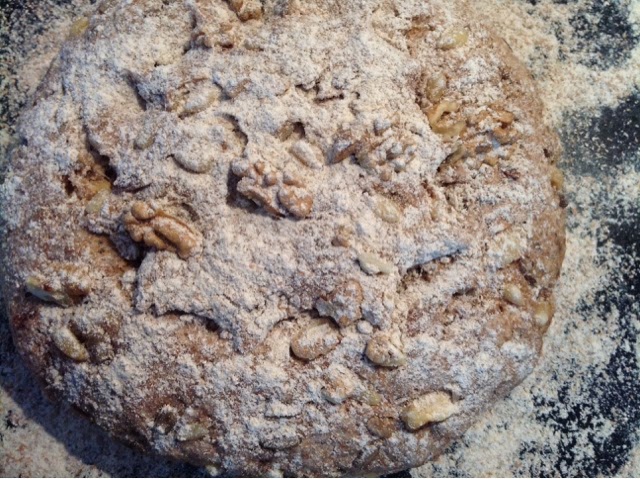
Wholemeal Seed & Nut Bread


makes 1 loaf

500g wholemeal flour
1 sachet (5.5g) fast-acting dreid yeast
1 tbsp Maldon sea salt
50g pine nuts
50g sunflower seeds
walnut halves for the top
40ml olive oil
300ml warm water
1. Mix all the dry ingredients (except the walnuts) together in a large bowl.
2. Add the oil and water and mix together with a spoon.
3. Bring the mixture together with your hand ... it will stick a little at first! But don't worry... Wetter is Better!
4. Knead in the bowl for about 5 minutes untill you have a silky dough.
5. Shape your loaf a place on a lined baking tray. Cover loosly with film and leave to proove for 2 hours.
6. Bake in a pre-heated oven at 220ºC for 20 minutes, then reduce to 200ºC for a further 20 minutes.
7. Turn out onto a cooling rack...

25/02/2014

White sourdough

Makes 1 small loaf


250g strong white flour (0,0)
4g Maldon sea salt
150g tepid water (filtered or bottled)
75g sourdough starter


1. Weigh out the dry ingredients separately form the wet.
2. Add the dry mix to the wet one and bring the lot together with a wooden spoon, then your hands.
3. Once you have a ball of dough and a cleanish bowl; it's time to get stuck in - kneed your dough for about 10 minutes. I drizzled a little olive oil onto a large wooden board and kneaded the dough until it reached the 'window pane effect'
4. place the dough back in the bowl, cover and prove for an hour.
5. Now you can shape your dough and place it onto a lined baking tray or place in a proving basket. In both cases you should flour the top(what's visible)
6. Leave to prove in a warm, moist place for 3 hours. I turned my oven into a proving oven by bringing the oven up to 140ºC and turning it off; tipping a small cup of water onto a lower baking tray and hey presto, you have a proving oven.
7. If you have used a proving basket - gently tip your loaf onto a lined baking, decorate the top and gently slide into the oven. Bake for about 30 minutes or until golden brown. 


Sourdough starter


ingredients to start

30g grapes very finely sliced
100ml water ( filtered or bottled)
50g strong white flour (0,0)
50g rye flour

I tried a couple of recipes before I ended up with a wonderful, living, breathing starter. This one worked. Once you have your starter, you will find that (unlike your peace Lilly) you can leave it for a few days and it won't die.

1. Mix the ingredients together and cover with a clean tea towel.
2. For the next 3 days add 50g of flour and 50ml of water and stir in well.
3. Now transfer 75g of your bubbly mixture to a tupperware container or a glass jar; and dispose of the rest... its job is done. Add 75g of flour and 75ml of water and stir in.
4. Whatever you remove for each loaf you make: you replace... half flour - half water.
5. Remeber this is a living thing; and it needs feeding - 75g flour and 75ml of water a day. 

* the best starter result is reached by doubling the quantity. So, if you are not making bread everyday, you need to discard some of the starter before feeding.
** When you are not going to make bread for a while you can slow your starter down by placing it in the fridge; where it will need feeding less often.

20/02/2014

Manchego and Caramelised onion Bread

makes 1 big loaf!

1kg strong (0.0) white flour
15g fast acting yeast
600ml tepid water
2tbsp sugar
2 level tbsp salt
1 onion
olive oil
250g Manchego cheese


1. Make a little hill out of the flour and make a large well in the centre. pour in half the water, then add the yeast, sugar and salt. Stir with a fork.
2. Continue to bring flour in from the surrounding walls whilst adding more water... until you have a thick, porridge-like consistency.
3. Now with the little remaining flour on your hands and the surface of the mixture; bring the mixture together and start kneeding:-
stretch the dough and fold half into the centre, then turn through 90º and repeat... for 10 minutes. You should have a silky and elastic dough.
4. Place the dough in a big bowl and flour the surface. Cover and leave to prove for about an hour... until doubled in size. Warm, moist environments are best. I sometimes turn my oven into a proving oven by:-
putting the oven on its lowest setting for 10 minutes, then turning it off and pouring a small cup of water onto a lower oven tray ( the bowl goes on a higher rack).
5. While you are waiting, caramelise the onions in a pan with a little olive oil. when they are a lovely golden brown, remove from the heat and set aside to cool.
6. Once the dough has doubled in size, it's time to 'knock it back' - I do this by folding in the cooled caramelised onions and manchego cheese. Shape your dough and cut whatever pattern you want into the surface., place on an oven-sheet lined baking tray.
7. flour the surface and loosly cover with film. Leave to prove again until doubled in size for about an hour.
8. 30 minutes into the second prove, light the oven and set to 180ºC.
9. Carefully remove the film and carefully slide the tray into the pre-heated oven... don't slam the oven door!
10. Bake for about 35 minutes, or until it is golden brown and when tapped on the bottom - sounds hollow.
11. Then leave to cool on a rack until you can safely cut and butter a slice!